Living near Boston Harbor offers beautiful waterfront views, historic neighborhoods, and convenient access to some of the city’s most desirable communities. However, owning a home in coastal areas such as South Boston (Southie), the Seaport District, East Boston, and portions of the North End also means dealing with a foundation challenge that many inland properties never experience—fluctuating tidal groundwater.
Unlike ordinary rainwater, tidal groundwater rises and falls every day as Boston Harbor responds to the Atlantic Ocean’s changing tides. Although this movement happens below ground and often goes unnoticed, it can place tremendous pressure against basement walls, especially in homes with aging concrete or masonry foundations.
Over time, this constant hydraulic force can cause walls to bow inward, cracks to widen, and groundwater to seep into basements. Many homeowners initially assume these problems are simply the result of an older home, when in reality the underlying cause may be the unique coastal environment surrounding the property.
Understanding how Boston Harbor influences groundwater beneath your home is the first step toward protecting your basement from long-term structural damage.
The Physics of Coastal Hydrostatic Pressure in Boston
How Boston Harbor’s Tides Affect Underground Foundations
A tidal water table is the natural fluctuation of underground groundwater levels caused by the rise and fall of nearby ocean tides. In coastal cities like Boston, groundwater beneath the surface is hydraulically connected to Boston Harbor. As ocean tides rise, groundwater levels beneath surrounding neighborhoods also rise. When the tide recedes, groundwater levels gradually fall again.
This daily cycle may seem insignificant, but below ground it creates a powerful force acting against basement foundations.
Many parts of South Boston, the Seaport District, East Boston, and sections of the North End were developed on reclaimed shoreline or naturally low-lying coastal land. These areas often contain highly permeable fill soils composed of sand, gravel, and other materials that readily allow groundwater to move through them.
As incoming high tides raise the surrounding groundwater, the saturated soils around a home’s foundation become increasingly heavy and waterlogged. The water trapped within these soils exerts hydrostatic pressure—the sideways force created when groundwater pushes against underground foundation walls.
An easy way to visualize hydrostatic pressure is to imagine pressing your hand against the wall of a swimming pool. Near the surface, the pressure is relatively small. As you move deeper into the water, the pressure pushing against your hand steadily increases.
Basement walls experience a similar effect.
When groundwater rises around the foundation, the increasing weight of the surrounding water pushes laterally against concrete or masonry walls. Unlike surface water that quickly drains away after a storm, tidal groundwater may continue exerting pressure throughout each tidal cycle, creating repeated structural stress day after day.
Over months and years, this continuous loading can gradually weaken basement walls, particularly older foundations that lack modern structural reinforcement.
King Tides, Nor’easters, and Boston’s Coastal Flood Risk
While daily tidal fluctuations already place stress on coastal foundations, certain weather events can dramatically increase the amount of groundwater surrounding a home.
One of the most significant is the occurrence of King Tides, also known as perigean spring tides.
King Tides occur when the gravitational pull of the moon and sun align in a way that produces unusually high astronomical tides. During these events, Boston Harbor reaches higher-than-normal water levels, causing the underground water table to rise even further beneath nearby neighborhoods.
Another major contributor is the powerful Nor’easter.
These intense coastal storms combine heavy rainfall, strong onshore winds, storm surge, and prolonged periods of elevated harbor water levels. As rainwater saturates the soil from above while tidal groundwater rises from below, the earth surrounding a basement foundation can become almost completely saturated.
The result is similar to placing a building inside an enormous, water-soaked sponge.
Instead of supporting the foundation with relatively dry soil, the surrounding ground becomes densely saturated, dramatically increasing the amount of hydraulic force pressing against basement walls. Thousands of pounds of lateral pressure may develop along the perimeter of a home’s foundation during prolonged storm events.
Several local conditions can amplify this pressure even further, including:
- High groundwater associated with Boston Harbor tides.
- Heavy New England rainfall.
- Coastal storm surge.
- Poor exterior drainage around the home.
- Impermeable pavement that limits natural groundwater absorption.
- Filled land common throughout South Boston and the Seaport District.
- Aging foundation waterproofing systems.
Because many of Boston’s coastal neighborhoods contain older homes originally constructed long before today’s waterproofing technologies existed, these structures often experience repeated cycles of rising groundwater throughout the year.
The foundation may successfully resist these forces for decades, but continual exposure to hydrostatic pressure gradually increases the likelihood of structural movement, cracking, and water intrusion.
Understanding Why Coastal Homes Face Greater Foundation Stress
Homes located farther inland generally experience groundwater fluctuations that are driven primarily by seasonal rainfall and snowmelt.
Coastal Boston properties face an additional challenge.
In neighborhoods bordering Boston Harbor, groundwater levels are influenced not only by precipitation but also by the predictable rhythm of the ocean itself. Every incoming tide can slightly increase groundwater pressure around the foundation, while every outgoing tide relieves some of that pressure before the process begins again.
This repeated loading and unloading creates a long-term cycle of structural stress that is unique to waterfront communities.
When combined with New England’s freeze-thaw cycles, aging concrete, settlement, and decades of normal building movement, tidal hydrostatic pressure becomes one of the leading contributors to basement wall deterioration in many coastal Boston homes.
Recognizing these environmental factors helps homeowners understand that recurring basement leaks, widening wall cracks, or bowing foundation walls may be symptoms of a larger structural issue rather than isolated maintenance problems.
Identifying the source of that pressure is the first step toward selecting the right long-term repair strategy—one that addresses not only the visible damage inside the basement but also the groundwater forces acting outside the foundation every day.
Structural Damage: How Tidal Pressure Bends Basement Walls
How Hydrostatic Pressure Causes Basement Walls to Bow
Concrete and masonry foundation walls are exceptionally strong when carrying the vertical weight of a building. They are far less effective, however, at resisting continuous sideways pressure generated by saturated soil and rising groundwater.
In coastal Boston neighborhoods, this lateral force increases every time the underground water table rises during high tides, King Tides, prolonged rainfall, or Nor’easter storm events.
Over time, the combination of saturated backfill and tidal groundwater can generate thousands of pounds of pressure against a basement wall. If this force exceeds the wall’s ability to resist bending, the foundation gradually begins to deform.
The earliest stage of failure is often wall deflection, commonly referred to as bowing.
Instead of remaining perfectly straight, the middle section of the wall slowly begins moving inward toward the basement. Because the greatest pressure is typically concentrated near the center of the wall, this area experiences the highest amount of structural stress.
As inward movement increases, the concrete or masonry begins developing visible cracking.
For poured concrete foundations, horizontal cracks frequently develop across the middle portion of the wall where bending stresses are greatest.
For concrete block (CMU) foundations, horizontal cracks commonly follow the mortar joints because these joints represent the wall’s weakest structural plane.
As bowing progresses, additional structural movement often creates:
- Vertical shear cracks near basement corners.
- Diagonal cracks extending from window openings.
- Separation between walls and floor framing.
- Localized wall bulging.
- Progressive inward rotation of the basement wall.
Unlike cosmetic shrinkage cracks that often remain unchanged for years, structural hydrostatic cracks tend to worsen gradually as groundwater continues applying repeated lateral pressure throughout each tidal cycle.
Without intervention, the wall may continue deforming until major structural stabilization becomes necessary.
Recognizing the Warning Signs of Coastal Foundation Distress
Many homeowners first notice foundation problems after discovering water inside the basement following a heavy storm.
While water intrusion is certainly a warning sign, it is often only one symptom of a larger structural issue caused by ongoing hydrostatic pressure.
Homes located near Boston Harbor, particularly in South Boston, East Boston, the Seaport District, and portions of the North End, should be inspected if any of the following conditions are present:
- Horizontal cracks running across basement walls.
- Basement walls that appear to lean or bow inward.
- Vertical or diagonal cracks forming near wall corners.
- Water seepage where the floor slab meets the foundation wall (commonly called the cold joint).
- White mineral deposits (efflorescence) on concrete or masonry surfaces.
- Persistent dampness or moisture stains after periods of high tide.
- Doors or windows directly above the basement becoming difficult to open or close.
- Musty odors indicating chronic moisture intrusion.
- Areas where paint or wall coatings begin peeling due to moisture pressure.
One particularly important warning sign is active movement.
If basement cracks appear to widen after periods of heavy rain, King Tides, or coastal flooding before becoming slightly less noticeable during drier weather, tidal groundwater pressure may be contributing to the structural movement.
These changing crack widths indicate that the foundation is responding to fluctuating groundwater loads rather than remaining structurally stable.
Because structural damage generally develops gradually, identifying these symptoms early often allows homeowners to stabilize the wall before significant reconstruction becomes necessary.
| Coastal Threat Factor | Physical Mechanism | Primary Wall Impact | Correct Engineering Fix |
| High Tide Water Table Rise | Rising harbor groundwater saturates surrounding soils, increasing lateral hydrostatic pressure. | Horizontal wall bowing and progressive structural deflection. | Carbon fiber wall reinforcement or galvanized steel wall braces combined with sub-slab drainage. |
| Nor’easter Storm Surges | Heavy rainfall and storm surge rapidly saturate surrounding soils while raising groundwater levels. | Water seepage along cold joints, widening wall cracks, and basement moisture intrusion. | Interior perimeter French drain with dual-battery-backup sump pump system. |
| Prolonged Tidal Pressure | Repeated daily groundwater fluctuations create long-term lateral loading against basement walls. | Corner shearing, diagonal cracking, inward wall rotation, and structural instability. | Heavy-duty steel I-beam bracing anchored into floor slabs and structural floor framing. |
Structural Solutions: Carbon Fiber Strapping vs. Steel Wall Bracing
Carbon Fiber Wall Reinforcement
Once a basement wall begins bowing inward, preventing additional movement becomes the primary objective.
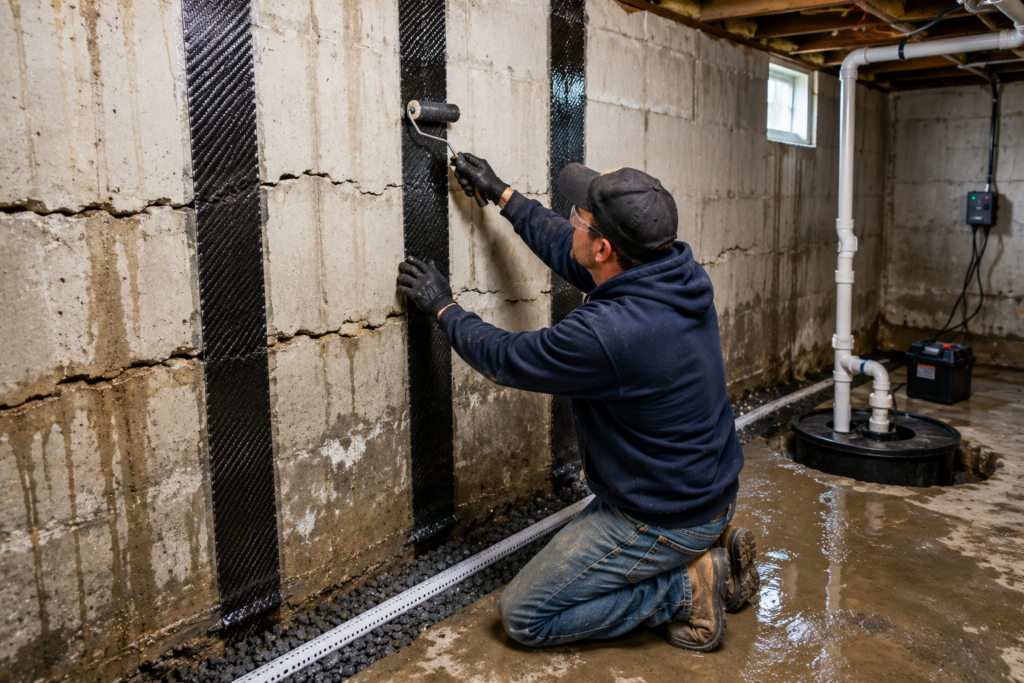
For walls experiencing mild to moderate structural deflection, one of the most effective modern reinforcement systems is the installation of industrial-grade carbon fiber straps.
Unlike bulky steel reinforcement, carbon fiber systems are extremely thin and lightweight while providing exceptional tensile strength. In fact, many structural carbon fiber composites possess tensile strengths significantly greater than structural steel while remaining resistant to corrosion, moisture, and chemical deterioration.
Installation begins by preparing the interior surface of the basement wall.
Technicians grind and clean the concrete before applying a high-strength structural epoxy specifically formulated for foundation reinforcement. Carbon fiber straps are then bonded vertically to the wall, creating a continuous reinforcement system that permanently resists additional inward movement.
Once the epoxy fully cures, the straps become an integral part of the wall itself.
Key advantages of carbon fiber reinforcement include:
- Exceptional tensile strength.
- No excavation required.
- Minimal disruption to finished basements.
- Virtually no loss of usable floor space.
- Long-term corrosion resistance.
- Fast installation compared to major structural reconstruction.
Although carbon fiber systems are highly effective at preventing additional wall movement, they are generally recommended only when structural deflection remains within engineering limits and the wall has not experienced severe displacement.
Heavy Steel I-Beam Wall Bracing
When hydrostatic pressure has pushed a basement wall inward by more than approximately two inches, engineers often recommend a more robust structural stabilization system.
In these situations, galvanized steel I-beam wall braces provide the mechanical strength needed to resist the tremendous lateral forces generated by saturated coastal soils.
Unlike carbon fiber straps, which primarily prevent additional flexing, steel wall braces actively redistribute structural loads across the foundation system.
Each steel beam is positioned vertically against the affected wall before being securely anchored into the concrete basement floor. The upper portion of each beam is then fastened to the home’s floor framing or engineered structural joists above.
Engineers carefully determine:
- Beam spacing.
- Steel size and thickness.
- Anchorage requirements.
- Floor slab connection details.
- Upper framing attachment points.
The galvanized coating helps protect the steel from long-term corrosion within damp basement environments, making these systems well suited for coastal homes exposed to elevated moisture levels.
Once installed, the braces mechanically resist the inward pressure exerted by saturated soils while helping prevent additional wall rotation and structural deterioration.
Installing engineered wall bracing is essential for remedying foundation damage in Boston, restoring structural stability to water-stressed homes.
By stabilizing the wall before further movement occurs, homeowners can often preserve the existing foundation while avoiding much more extensive structural reconstruction in the future.
Pressure Relief: The Essential Role of Interior Waterproofing
Why Structural Repairs Alone Aren’t Enough
Stabilizing a bowing basement wall is a critical step in protecting your home’s structural integrity, but reinforcement alone does not solve the underlying problem.
Whether engineers install carbon fiber straps or galvanized steel I-beam braces, these systems are designed to prevent additional wall movement. They strengthen the wall and help it resist future lateral pressure, but they do not remove the groundwater pressing against the exterior of the foundation.
Think of it this way:
Installing wall reinforcement without addressing groundwater pressure is similar to reinforcing the side of a dam while allowing the water behind it to continue rising. The wall may remain standing, but the tremendous force acting against it never disappears.
Over time, untreated hydrostatic pressure will continue searching for the path of least resistance.
That pressure may eventually force groundwater through:
- Tiny hairline cracks in the concrete.
- Existing mortar joints.
- Pipe penetrations.
- Utility openings.
- Expansion joints.
- The cold joint, where the basement floor slab meets the foundation wall.
In severe cases, hydrostatic pressure can even push upward beneath the basement floor, causing moisture intrusion through floor cracks or creating localized slab movement.
For homeowners near Boston Harbor, where groundwater levels fluctuate daily with the tides, simply reinforcing the wall without relieving water pressure leaves the root cause of the problem unchanged.
A complete repair strategy must address both structural stability and groundwater management.
Sub-Slab Drainage and Dual Sump Pump Systems
The most effective long-term solution combines structural wall reinforcement with a professionally engineered interior waterproofing system designed to intercept groundwater before it reaches the basement walls.
One of the most common methods is the installation of an interior perimeter French drain, also called a sub-slab drainage channel.
Rather than attempting to stop groundwater outside the home, this system works by controlling the water after it reaches the foundation.
Installation typically begins by carefully removing a narrow section of the concrete floor around the perimeter of the basement. A drainage channel is then excavated below the floor slab and fitted with clean drainage stone and perforated piping.
As groundwater rises beneath the foundation, it naturally flows into this drainage system instead of building pressure against the walls.
The collected water is directed toward a heavy-duty sump basin where a high-capacity sump pump safely discharges it away from the home’s foundation.
For coastal Boston properties, many engineers recommend installing a dual-pump system with battery backup.
This configuration provides several important advantages:
- Continuous operation during power outages.
- Redundant pumping capacity during major storms.
- Improved protection during Nor’easters.
- Increased reliability during prolonged high-tide events.
- Reduced flood risk if one pump requires maintenance.
Together, the drainage channel and sump pump system dramatically reduce hydrostatic pressure by lowering groundwater levels beneath the basement floor before water can accumulate behind the foundation walls.
Pairing wall reinforcement with engineered sub-slab interior drainage systems ensures that subterranean tidal pressure is continuously relieved before structural failure recurs.
When properly designed, this dual approach not only protects the structure but also creates a drier, healthier basement environment while reducing the likelihood of future water intrusion.
Frequently Asked Question
Will Waterproof Paint Stop Hydrostatic Pressure?
No.
Waterproof paint can temporarily improve the appearance of a damp basement wall, but it does not stop hydrostatic pressure.
The force pushing against your foundation originates outside the wall, where groundwater builds pressure within the surrounding soil. Applying waterproof paint to the inside surface simply covers the symptoms—it does not reduce the water pressure itself.
In many cases, trapped moisture eventually finds another path into the basement by traveling through:
- New cracks.
- Existing cold joints.
- Floor slab openings.
- Utility penetrations.
- Areas surrounding previously repaired cracks.
As hydrostatic pressure continues building, coatings may blister, peel, or separate from the wall because water pressure remains active behind them.
For homes experiencing recurring moisture intrusion or structural wall movement, effective long-term protection typically requires:
- Structural reinforcement where necessary.
- Proper groundwater drainage.
- Interior perimeter drainage systems.
- Reliable sump pump installation.
- Routine foundation inspections.
Managing the groundwater is what protects the foundation—not simply covering the inside surface with waterproof coatings.
Schedule a Coastal Foundation & Moisture Evaluation
If your home is located in South Boston, the Seaport District, East Boston, the North End, or another neighborhood influenced by Boston Harbor, recurring basement moisture should never be ignored.
Horizontal wall cracks, bowing foundation walls, persistent dampness, or water seepage along the basement floor may indicate that hydrostatic pressure is actively affecting your home’s structural stability.
Because coastal groundwater conditions are constantly changing, identifying the true source of the problem requires more than a quick visual inspection.
At Boston Foundation Repair, our comprehensive coastal foundation evaluations examine both the structural condition of your foundation and the groundwater conditions surrounding your home.
Our inspections typically include:
- Foundation wall plumb and bowing measurements.
- Crack mapping and structural movement assessment.
- Moisture readings throughout the basement.
- Evaluation of hydrostatic pressure indicators.
- Inspection of existing drainage systems.
- Assessment of sump pump performance.
- Foundation waterproofing recommendations.
- Structural stabilization recommendations tailored to coastal conditions.
By evaluating both the structure and the groundwater affecting it, we can develop a repair strategy that addresses the underlying cause of the problem rather than simply treating its symptoms.
Ignoring bowing basement walls or recurring groundwater intrusion can lead to progressively worsening structural damage, costly repairs, and an increased risk of basement flooding during future high tides or severe coastal storms.
Schedule your professional coastal foundation and moisture evaluation today. Our experienced team will help you protect your home’s structural integrity with engineered solutions designed specifically for the unique groundwater conditions found throughout Boston’s historic waterfront neighborhoods.