
Cambridge is home to some of New England’s most treasured historic neighborhoods, where centuries-old homes continue to stand as a testament to exceptional craftsmanship. Many of these houses were built long before poured concrete foundations became the standard, relying instead on traditional fieldstone foundations that have supported structures for well over a hundred years. While these foundations were remarkably durable for their time, they require a completely different approach to maintenance and repair than modern concrete systems.
Historic foundation repair in Cambridge isn’t simply about fixing cracks or stopping water intrusion. It involves understanding how these original masonry systems were engineered to function, why they deteriorate over time, and how modern repair methods can sometimes cause more harm than good. Homeowners who own pre-1920 properties often inherit foundations that are still structurally serviceable, provided they are repaired using materials and techniques compatible with their original construction.
Whether your home is located near Harvard Square, Mid-Cambridge, Cambridgeport, Riverside, or Old Cambridge, preserving the integrity of a historic fieldstone foundation begins with understanding how these unique structures were designed to perform.
Understanding Historic Foundation Engineering in Cambridge
What Is a Fieldstone Foundation?
A fieldstone foundation, also known as a rubble masonry foundation, is a load-bearing wall system constructed from uncut, locally sourced glacial stones carefully stacked and bedded in a soft, high-calcium lime mortar. Before modern concrete foundations became common, these stone walls formed the structural base for thousands of homes throughout New England. From the eighteenth century through the early twentieth century, fieldstone foundations were the standard method of residential construction across many older Cambridge neighborhoods, including Harvard Square, Mid-Cambridge, Cambridgeport, and surrounding historic districts.
Rather than using manufactured concrete blocks or reinforced concrete walls, early builders relied on the strength of naturally occurring stone combined with carefully prepared lime mortar. Each stone was individually selected and positioned so that the wall functioned as a unified structural system capable of supporting substantial vertical loads. Although these foundations may appear irregular compared to today’s smooth concrete walls, they were engineered with remarkable skill using the building materials available at the time.
Many of Cambridge’s Victorian homes, Colonial residences, brick row houses, and early multi-family properties still rest on their original fieldstone foundations today. With proper maintenance and historically appropriate repairs, these foundations can continue supporting structures for many decades to come.
Why Historic Foundations Were Designed to Breathe
One of the biggest misconceptions homeowners have is assuming that historic fieldstone foundations should perform exactly like modern poured concrete walls. In reality, they were designed according to an entirely different engineering philosophy.
Unlike rigid concrete foundations, traditional fieldstone walls were intentionally built to remain flexible and breathable. The stones themselves provide the structural strength, while the surrounding lime mortar serves as a softer, sacrificial material that accommodates minor settlement, seasonal expansion, and natural movement within the surrounding soil. Instead of resisting every small shift, the mortar absorbs these stresses, helping protect the larger stone components from damage.
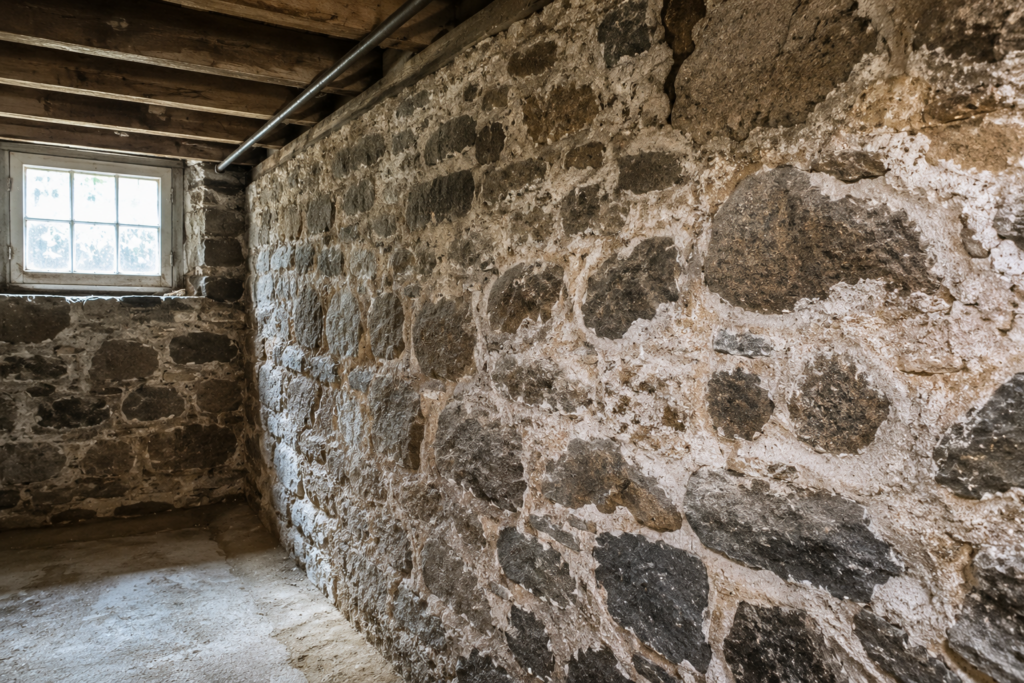
Equally important is the foundation’s ability to manage moisture. Historic lime mortar is naturally vapor permeable, allowing groundwater moisture to migrate slowly through the wall and evaporate over time. Rather than trapping moisture inside the masonry, the wall is able to “breathe,” helping regulate moisture levels without placing excessive pressure on the stone itself.
This breathable building envelope was especially well suited to New England’s changing seasons. During periods of heavy rainfall, snowmelt, or elevated groundwater, small amounts of moisture could pass through the mortar joints without significantly damaging the foundation. As conditions became drier, the wall naturally released that moisture back into the surrounding air. This continuous cycle helped preserve both the stone and mortar for generations.
The relationship between the fieldstones and the lime mortar is what makes these historic foundations so unique. While the mortar slowly wears away over time, it is actually performing the role it was designed to serve—protecting the surrounding masonry by absorbing weathering instead of allowing the stones themselves to deteriorate.
Unfortunately, many modern repair methods fail to recognize this critical principle. Using rigid Portland cement, waterproof coatings, or impermeable sealants can interrupt the foundation’s natural moisture movement, trapping water inside the wall where it eventually damages the historic masonry. Understanding how these original systems function is the first step toward preserving them correctly.
The Primary Culprit: Lime Mortar Degradation and Efflorescence
Even though fieldstone foundations were built to last, no building material remains unchanged forever. After more than a century of continuous exposure to groundwater, seasonal freeze-thaw cycles, fluctuating temperatures, and naturally occurring minerals within the soil, the original lime mortar gradually begins to deteriorate.
Unlike the stone itself, lime mortar was never intended to last indefinitely. It was designed as the component that would slowly weather first, allowing it to be periodically replaced while preserving the much more valuable fieldstones. This process, known as mortar degradation, is one of the most common issues affecting historic foundations throughout Cambridge today.
Over decades, moisture repeatedly enters and exits the mortar joints. Dissolved minerals, natural salts, and underground gases slowly weaken the chemical bonds within the lime mortar. As these bonds break down, the once-solid joints begin losing their strength and cohesion. What was originally a firm mortar joint gradually transforms into a soft, sandy material that can often be scraped away by hand.
As more mortar disappears, the interlocking relationship between the surrounding fieldstones begins to weaken. Individual stones may become loose, small gaps develop between the masonry, and portions of the wall become increasingly vulnerable to additional movement caused by soil pressure and seasonal weather conditions.
Because this deterioration occurs gradually over many decades, homeowners often don’t recognize the warning signs until more visible structural symptoms begin to appear. Identifying mortar degradation early allows repairs to be completed before more extensive stabilization becomes necessary.
Identifying Efflorescence and Structural Spalling
One of the most common signs of moisture movement within a historic fieldstone foundation is the appearance of a white, chalky residue on basement walls. This substance, known as efflorescence, is often mistaken for mold or mildew, but it is actually a mineral deposit left behind as water moves through masonry.
Here’s how the process works. Groundwater naturally contains dissolved minerals and salts collected from the surrounding soil. As moisture migrates through the lime mortar joints and porous fieldstones, it carries these dissolved minerals toward the interior surface of the basement wall. Once the water reaches open air, it evaporates, leaving behind a white crystalline residue that gradually accumulates on the masonry surface.
While efflorescence itself is not structurally harmful, it serves as an important warning sign that moisture is actively moving through the foundation. For historic fieldstone walls, this often indicates that the original lime mortar is becoming more porous with age or that drainage conditions around the home should be evaluated.
If ignored for many years, the same moisture movement that produces efflorescence can eventually lead to a more serious condition known as spalling.
Spalling occurs when dissolved salts crystallize within the tiny pores of the stone or mortar. As these crystals repeatedly expand and contract through changing moisture conditions and New England’s freeze-thaw cycles, they generate internal pressure that slowly fractures the masonry from within. Over time, the surface of the stone begins to flake, chip, or break away, exposing fresh material beneath and accelerating deterioration.
Homeowners with older Cambridge homes should periodically inspect their basements for these common warning signs:
- White powdery deposits on fieldstone walls or mortar joints (efflorescence)
- Mortar joints that appear sandy, crumbly, or recessed
- Loose or shifting fieldstones
- Small flakes or chips breaking away from stone surfaces (spalling)
- Damp basement walls or persistent musty odors
- Bulging sections of masonry walls
- Water seepage following heavy rainfall or spring snowmelt
These symptoms do not necessarily mean the entire foundation is failing, but they do indicate that the original masonry system is beginning to lose some of its protective characteristics. Addressing these issues early often allows repairs to remain localized rather than requiring more extensive structural restoration later.
Why Modern Portland Concrete Can Destroy Old Stone Foundations
One of the most damaging mistakes homeowners make is assuming that stronger materials automatically produce stronger repairs.
For modern concrete foundations, Portland cement is an excellent building material. However, historic fieldstone foundations were never designed to work with rigid Portland cement products. In fact, using modern concrete to repair historic masonry can unintentionally accelerate deterioration instead of preventing it.
Unfortunately, many repairs completed during the 1950s through the 1990s replaced deteriorated lime mortar with Portland cement because it was widely believed to be a stronger, longer-lasting alternative. While the cement itself may be stronger, historic masonry does not benefit from increased rigidity. These foundations depend on controlled flexibility, and replacing soft lime mortar with hard Portland cement fundamentally changes how the wall behaves under structural loads.
Historic fieldstone walls naturally experience small amounts of seasonal movement as surrounding soils expand and contract. Lime mortar was intentionally designed to absorb these minor stresses without transferring excessive force into the stones themselves. Portland cement behaves very differently. Because it is significantly harder and less flexible, it resists movement rather than accommodating it.
The same issue occurs with moisture management.
Traditional lime mortar allows water vapor to migrate gradually through the wall and evaporate harmlessly. Portland cement, waterproof coatings, and many impermeable masonry sealers dramatically reduce this natural moisture movement. Instead of escaping through the mortar joints, groundwater becomes trapped behind the harder repair material.
As moisture accumulates inside the wall, hydrostatic pressure increases while dissolved salts continue moving through the masonry. During winter, trapped moisture expands as it freezes. During warmer months, repeated wetting and drying cycles create additional internal stress. Rather than protecting the foundation, the rigid repair forces these pressures into the surrounding historic fieldstones.
Over time, the stones themselves begin to crack, fracture, or separate from the wall because they have become the weakest component in the system. What originally could have been corrected through relatively straightforward mortar repointing may eventually require extensive masonry reconstruction simply because incompatible repair materials were used.
Waterproof basement paints can create similar problems.
Although these coatings may temporarily hide damp walls, they often prevent historic masonry from releasing moisture naturally. Water that cannot escape continues to build pressure behind the coating until it causes peeling paint, trapped moisture, deteriorating mortar, or additional stone damage. For breathable fieldstone foundations, treating the source of moisture is almost always more effective than sealing the interior surface.
Because every historic foundation is unique, selecting compatible repair materials is one of the most important decisions in the restoration process. Preserving the original engineering principles of the wall helps maintain both its structural performance and its historic character.
Structural Stabilization and Masonry Repointing Solutions
Not every historic fieldstone foundation requires major structural reconstruction. In many cases, the stone itself remains remarkably durable even after more than a century of service. The key is determining whether the deterioration is limited to aging mortar or whether the foundation has begun experiencing structural movement that affects the stability of the entire building.
When mortar loss becomes extensive, individual fieldstones may gradually loosen, allowing sections of the wall to shift outward or settle unevenly under the weight of the structure above. Bowing walls, significant displacement, widening cracks, or stones that have completely separated from the surrounding masonry typically indicate that structural stabilization should occur before cosmetic repairs are attempted.
In these situations, contractors may first install temporary structural shoring to safely support the building while repairs are completed. Depending on the severity of the settlement, additional underpinning using engineered concrete footings or strategically placed steel supports may also be necessary to restore stability beneath the historic masonry.
Addressing these compound issues requires a unified approach combining structural stabilization with specialized historic foundation repair in Cambridge to handle structural load transfers safely.
Once the structural movement has been properly addressed, attention can then shift toward restoring the original masonry system using historically compatible materials—a process that preserves both the foundation’s structural integrity and its architectural significance.
The Art of Historical Masonry Repointing
Once a historic fieldstone foundation has been properly stabilized, the next step is restoring the masonry itself. For most homes, this means repairing the deteriorated mortar joints rather than replacing the original stones. This specialized process, known as historical masonry repointing, is one of the most important preservation techniques for extending the life of a fieldstone foundation.
Unlike modern masonry repairs, repointing historic foundations is a careful, hands-on process that requires patience and an understanding of traditional building materials. The goal is not to make the wall stronger by adding harder mortar. Instead, the objective is to restore the foundation’s original performance by replacing deteriorated mortar with a compatible material that behaves like the historic mix.
The restoration process typically includes the following steps:
- Carefully inspect the foundation to identify deteriorated joints, displaced stones, and areas requiring structural stabilization.
- Remove loose, powdery mortar by hand to a depth of at least one inch using specialized masonry tools. Power grinders are generally avoided because they can easily damage the surrounding fieldstones.
- Clean the exposed joints to remove dust, loose debris, and deteriorated material, creating a sound surface for the new mortar.
- Prepare a custom-blended, low-strength lime mortar formulated to closely match the chemical composition, flexibility, permeability, and appearance of the original historic mortar.
- Press the new mortar deeply into each joint by hand, ensuring complete contact around the surrounding stones without creating unnecessary pressure.
- Allow the mortar to cure slowly under controlled moisture conditions so it develops the proper strength without shrinking or cracking.
Because lime mortar cures differently than Portland cement, rushing the process can reduce the durability of the repair. Proper curing allows the mortar to carbonate naturally, gradually returning it to a stable condition while maintaining the flexibility needed for historic masonry.
The result is a restored foundation that continues to function the way its original builders intended. Instead of forcing the wall to become rigid, the new mortar once again serves as the sacrificial element that protects the surrounding fieldstones from movement, moisture, and long-term weathering.
This delicate process requires expert historical masonry repointing to ensure the new mortar yields to environmental pressures just like the original mix did.
When performed correctly, repointing not only improves structural performance but also preserves the architectural authenticity of some of Cambridge’s most historic homes.
Navigating Cambridge Historical Commission Guidelines
Owning a historic home in Cambridge often involves more than selecting the correct repair materials. Many neighborhoods fall within designated historic districts where exterior alterations and certain structural work are subject to preservation guidelines intended to protect the city’s architectural heritage.
Areas such as Old Cambridge, Half Crown–Marsh, and several other locally designated historic districts are overseen by the Cambridge Historical Commission. Depending on the scope of the proposed work, homeowners may be required to obtain a Certificate of Appropriateness or receive formal approval before making visible changes to masonry, foundation walls, or other historically significant architectural features.
While routine maintenance may not always require review, larger restoration projects involving exposed fieldstone, exterior masonry reconstruction, visible foundation modifications, or structural alterations can fall under the Commission’s jurisdiction. Failing to obtain the appropriate approvals may result in project delays, additional expenses, or stop-work orders until compliance requirements are satisfied.
Working with contractors who understand both structural engineering principles and historic preservation standards can significantly simplify the restoration process. Experienced professionals recognize when repairs must balance modern building safety with preservation requirements, helping homeowners maintain compliance while protecting the architectural character that makes Cambridge’s historic neighborhoods so distinctive.
Because every historic property presents unique construction methods and preservation considerations, planning repairs carefully before work begins often leads to better long-term outcomes and fewer unexpected complications.
Frequently Asked Question
Should a historic fieldstone foundation always stay completely dry?
Not necessarily.
Unlike modern poured concrete foundations, historic fieldstone walls were designed to be breathable rather than completely waterproof. Small amounts of seasonal moisture movement through lime mortar joints can be considered normal, especially in older basements. The original construction allowed moisture vapor to migrate through the wall and evaporate naturally without placing excessive pressure on the masonry.
However, standing water, persistent leaks, widening mortar joints, loose fieldstones, bulging walls, recurring efflorescence, or visible structural movement should never be ignored. These conditions often indicate that the foundation requires professional evaluation to determine whether deterioration has progressed beyond normal aging.
The objective is not to seal every historic foundation completely, but rather to preserve its ability to manage moisture while maintaining long-term structural stability.
Preserving Cambridge’s Historic Housing Stock
Historic fieldstone foundations are an important part of Cambridge’s architectural identity. Many of the city’s Victorian homes, Colonial residences, brick townhouses, and early twentieth-century multi-family buildings continue to rely on foundation systems that have successfully supported them for well over a century. With proper care, these foundations can continue serving future generations just as effectively.
The key is recognizing that historic stone basements require a completely different approach than modern poured concrete foundations. Using incompatible repair materials, sealing moisture inside the wall, or overlooking deteriorating lime mortar can unintentionally shorten the life of a foundation that might otherwise remain structurally sound for decades.
At Boston Foundation Repair, we understand that preserving historic homes requires more than simply repairing visible damage. Every evaluation considers the original construction methods, existing structural conditions, moisture movement, and long-term preservation goals before recommending an appropriate repair strategy. Whether your property requires structural stabilization, foundation repair, or historically accurate masonry restoration, our team focuses on solutions that respect both the engineering and architectural significance of your home.
If you’ve noticed crumbling mortar joints, loose fieldstones, bowing basement walls, recurring moisture, or signs of structural movement, scheduling a professional inspection is the best place to start. Early intervention often allows repairs to remain less invasive while helping preserve the original craftsmanship that makes Cambridge’s historic homes so valuable.