
Cambridge homeowners often associate foundation problems with heavy rain, settling soil, or aging concrete, but New England winters create another powerful threat hiding beneath the ground. Every winter, freezing temperatures cause moisture trapped within the surrounding soil and concrete to repeatedly freeze and thaw, placing enormous stress on foundation walls, footings, crawl spaces, and basement floors. While the damage may begin as a small hairline crack, years of seasonal movement can gradually develop into significant structural deterioration.
Foundation crack repair in Cambridge, MA frequently becomes necessary after repeated freeze-thaw cycles weaken concrete and shift foundation components. Older homes throughout neighborhoods such as Mid-Cambridge, Cambridgeport, Riverside, North Cambridge, East Cambridge, and areas surrounding Fresh Pond often experience decades of seasonal frost movement. Foundations built before modern insulation practices and frost-protected construction standards are especially vulnerable to expanding frozen soil, groundwater infiltration, and concrete deterioration.
Understanding how winter weather affects your home’s foundation allows problems to be identified before they become costly structural repairs. Whether you’ve noticed widening cracks, water entering the basement during spring thaw, uneven floors, or deteriorating concrete surfaces, recognizing the effects of frost heave can help protect your property for years to come.
The Science of New England Freeze-Thaw Weather
What Are Freeze-Thaw Cycles?
A freeze-thaw cycle is the process in which water trapped within subterranean soil, porous concrete, or masonry freezes, expands by approximately 9 percent in volume, and subsequently thaws as temperatures rise. This continual cycle of expansion and contraction generates repeated mechanical stress within underground foundation systems. Over time, these cyclic forces weaken concrete, enlarge existing cracks, shift structural components, and contribute to long-term deterioration of basement walls, crawl spaces, slabs, and foundation footings.
Unlike a single freezing event, freeze-thaw damage is cumulative. Every time moisture freezes, it expands against the surrounding material. When temperatures rise, the ice melts and creates additional space for new groundwater to enter. The next freeze repeats the process, gradually widening microscopic fractures that were previously invisible.
Concrete is particularly susceptible because it naturally contains thousands of tiny capillary pores. Even high-quality poured concrete absorbs small amounts of groundwater over time. During prolonged periods of sub-freezing weather, that trapped moisture transforms into ice, exerting internal pressure throughout the concrete matrix. Repeated winter cycles slowly weaken the material from the inside out, increasing the likelihood of cracking, surface deterioration, and structural instability.
The surrounding soil experiences similar movement. Moisture trapped between soil particles freezes and expands, causing the ground itself to shift vertically and horizontally. These soil movements transfer significant forces directly into foundation walls and footings, especially when groundwater levels remain elevated throughout the winter season.
Many homeowners believe foundation cracks appear suddenly after a harsh winter. In reality, the damage usually develops gradually over many seasons as countless freeze-thaw cycles repeatedly stress the foundation until visible signs begin to appear.
Why Cambridge Foundations Face Greater Winter Stress
Cambridge’s climate and soil conditions make freeze-thaw damage a recurring concern for homeowners throughout the city.
Located within Middlesex County, Cambridge experiences prolonged periods of freezing temperatures each winter. Local building practices recognize this by requiring foundation footings to extend below the region’s established 48-inch (4-foot) frost depth. This depth represents the point below which soil is generally protected from seasonal freezing and frost-related movement.
Any footing, crawl space, porch addition, garage slab, retaining wall, or shallow foundation constructed above this frost depth may be exposed to expanding frozen soil during severe winter weather. As moisture within the surrounding ground freezes, it exerts tremendous pressure against concrete surfaces while simultaneously lifting and shifting the soil supporting the structure.
Older Cambridge homes are often at greater risk. Many historic properties were originally constructed before today’s frost-protection standards became common, and later additions may not always have been built with adequate footing depth or insulation. Detached garages, enclosed porches, sunrooms, and crawl space additions are particularly susceptible to frost-related movement when shallow foundations are exposed to repeated freezing conditions.
Seasonal weather patterns further increase the risk. Snow accumulates throughout the winter before melting during brief warm periods. Meltwater then infiltrates the surrounding soil, only to refreeze when temperatures quickly drop overnight. Each new freeze introduces additional expansion forces against the foundation, creating a repeating cycle that gradually accelerates structural deterioration year after year.
For many Cambridge homeowners, the first visible warning signs don’t appear until several winters have already passed. Small cracks begin widening, basement walls develop moisture intrusion during spring thaw, and concrete surfaces start showing signs of flaking or deterioration. These symptoms often indicate that freeze-thaw damage has been affecting the foundation long before it became visible inside the home.
The Mechanics of Frost Heave: How Ice Lifts Concrete Footings
Not all foundation movement is caused by settlement. During New England winters, an equally destructive force can move a home in the opposite direction.
This process is known as frost heave.
Rather than allowing the foundation to sink into the ground, frost heave occurs when frozen soil expands beneath or alongside the structure, physically lifting portions of the foundation upward. Even relatively small amounts of vertical movement can place tremendous stress on basement walls, footings, slabs, crawl spaces, and the structural framing above.
Understanding how frost heave develops helps explain why some foundation cracks seem to worsen every winter before partially closing again during warmer months. The seasonal movement is often a direct response to freezing groundwater beneath and around the foundation—not simply normal aging or concrete shrinkage.
Adfreezing and Upward Frost Heave
One of the lesser-known but highly destructive mechanisms behind frost damage is adfreezing.
Adfreezing occurs when saturated soil freezes directly against the exterior surface of a concrete foundation wall, footing, or pier. Instead of simply freezing beside the foundation, the frozen soil bonds tightly to the concrete surface, effectively gripping the structure.
As freezing temperatures penetrate deeper into the ground, additional moisture turns to ice and expands upward. Because the frozen soil is now attached to the foundation wall, that upward movement can literally pull portions of the structure with it.
This upward lifting force is known as frost heave.
Depending on the amount of groundwater present and the depth of freezing, frost heave may cause:
- Vertical displacement of foundation walls or footings.
- Uneven basement or crawl space floors.
- Cracks developing near wall corners and window openings.
- Separation between structural framing and foundation walls.
- Doors and windows that suddenly become difficult to open or close.
- Differential movement between original foundations and later home additions.
The effects often become most noticeable during late winter or early spring when frozen ground begins thawing unevenly. As different portions of the foundation settle back at varying rates, new structural stresses may develop throughout the building.
Lateral Earth Pressure from Frozen Backfill
Freeze-thaw cycles do more than lift foundations—they also generate powerful sideways forces against basement walls.
After periods of snowmelt or winter rain, water naturally fills the backfill soil surrounding the home’s foundation. If temperatures then fall rapidly overnight, that moisture freezes within the surrounding soil before it has an opportunity to drain away.
As the trapped groundwater turns to ice, it expands outward in every direction.
This frozen backfill creates significant lateral earth pressure against the exterior foundation walls. Unlike hydrostatic pressure, which results primarily from standing groundwater, frozen soil combines the weight of saturated earth with the expansive force of ice, producing thousands of pounds of horizontal pressure across the basement wall.
Over repeated winters, these seasonal forces may contribute to:
- Horizontal cracks across poured concrete or block walls.
- Inward bowing of basement walls.
- Widening structural fractures.
- Water intrusion during spring thaw.
- Progressive weakening of the foundation system.
When existing cracks are already present, freeze-thaw expansion often accelerates their growth. Water enters the damaged area during warmer periods, freezes again during the next cold spell, and expands the crack even further. This repeating cycle is one of the primary reasons seemingly minor foundation cracks can evolve into significant structural repairs if left untreated.
Concrete Spalling and Micro-Fractures: The Internal Destruction
How Trapped Moisture Destroys Concrete from the Inside Out
Concrete may appear solid and impermeable, but it actually contains thousands of microscopic pores and capillary channels that absorb small amounts of groundwater over time. In many ways, an unsealed foundation wall behaves like a hard sponge. Moisture gradually migrates into the concrete, remaining trapped beneath the surface until freezing temperatures arrive.
As winter temperatures fall below freezing, the absorbed water turns to ice and expands by approximately 9 percent. Because the surrounding concrete cannot expand at the same rate, tremendous internal pressure develops within the concrete matrix itself. Rather than simply cracking on the surface, the concrete begins breaking apart from the inside out.
Initially, the damage may be nearly invisible. Tiny micro-fractures form around the aggregate and cement paste, weakening the internal structure without producing obvious surface cracks. However, each subsequent freeze-thaw cycle enlarges these microscopic fractures, allowing even more groundwater to penetrate the concrete. Over several winters, this repeating process accelerates deterioration and significantly reduces the material’s long-term durability.
Eventually, the weakened surface begins to separate from the underlying concrete. This condition is known as concrete spalling.
Common signs of spalling include:
- Flaking or peeling concrete surfaces.
- Chipped corners and exposed aggregate.
- Small pits developing across basement walls or slabs.
- Crumbling concrete around foundation cracks.
- Loose concrete scaling away from the wall.
- Progressive enlargement of previously minor surface defects.
As spalling progresses, what once appeared to be harmless cosmetic wear can expose deeper structural cracks beneath the surface. Water infiltration becomes easier, reinforcing steel may eventually become vulnerable to corrosion, and freeze-thaw deterioration accelerates even further.
For this reason, early concrete restoration plays an important role in protecting the structural integrity of a foundation. Repairing surface pitting before ice opens structural gaps requires specialized techniques for restoring spalled concrete surfaces before winter moisture sets in.
Proper concrete repair not only restores damaged surfaces but also helps reduce future moisture penetration, extending the service life of basement walls and other structural concrete elements.
Diagnostic Checklist: Winter Cracks vs. Structural Failure
Evaluating Basement Crack Behavior
Not every crack in a basement wall indicates a serious structural problem. Concrete naturally develops minor shrinkage cracks as it cures, and some hairline imperfections remain stable for decades without affecting the home’s structural performance.
The challenge for homeowners is determining whether a crack represents normal aging or active movement caused by frost heave and repeated freeze-thaw cycles.
One of the most reliable indicators is seasonal behavior.
Cracks caused by frost movement often change throughout the year. During winter, freezing groundwater expands within the surrounding soil and concrete, causing cracks to widen as pressure increases. During warmer months, those same cracks may partially close as frozen soils thaw and the foundation settles back toward its original position.
This repeated seasonal movement is very different from stable shrinkage cracks that remain essentially unchanged year after year.
As a general guideline:
Cosmetic Shrinkage Cracks
These cracks are usually not associated with structural foundation movement.
Characteristics include:
- Thin cracks generally less than 1/16 inch wide.
- Uniform width from top to bottom.
- Primarily vertical orientation.
- Little or no seasonal change.
- No wall displacement or bowing.
- No active water intrusion.
Although these cracks should still be monitored, many remain stable and require only periodic observation unless moisture becomes a concern.
Freeze-Thaw and Frost Heave Cracks
Structural cracks caused by winter movement typically display much different characteristics.
Warning signs include:
- Diagonal or horizontal crack patterns.
- Cracks wider at the top or bottom.
- Visible widening during winter months.
- Partial closing during warmer seasons.
- Water seepage during spring thaw.
- Nearby concrete spalling or deteriorating surfaces.
- Bowing foundation walls or uneven floors.
- Doors and windows that begin sticking after winter.
When several of these symptoms occur together, they often indicate active structural movement rather than simple cosmetic cracking.
Because seasonal movement tends to become progressively worse over time, professional evaluations are recommended before additional freeze-thaw cycles enlarge the damaged area.
| Freeze-Thaw Mechanism | Physical Cause | Observed Structural Symptom | Engineering Fix |
| Adfreezing / Upward Heave | Soil freezes directly to exterior foundation walls, pulling upward during frost expansion. | Vertical wall shearing, uneven floor lifting, sticking doors and windows. | Deep helical piers anchored below the 48-inch frost depth line. |
| Lateral Frost Expansion | Saturated backfill freezes overnight, expanding horizontally against foundation walls. | Horizontal wall cracks, inward wall bowing, basement wall bulging. | Carbon fiber wall straps or galvanized steel wall braces. |
| Pore Water Spalling | Moisture trapped inside concrete pores expands by approximately 9% when frozen. | Surface crumbling, flaking concrete, exposed aggregate, expanding hairline cracks. | High-pressure polyurethane or structural epoxy injection combined with concrete sealing. |
Injecting and Sealing Structural Fractures
Once freeze-thaw damage has produced structural cracks, simply covering the surface with masonry caulk or concrete patching compound is rarely a permanent solution.
Surface repairs only hide the visible crack while allowing moisture to continue penetrating deeper into the foundation. During the next winter, trapped groundwater freezes again, placing additional pressure on the repaired area and often causing the crack to reopen.
Professional structural repairs instead address the crack from within the concrete itself.
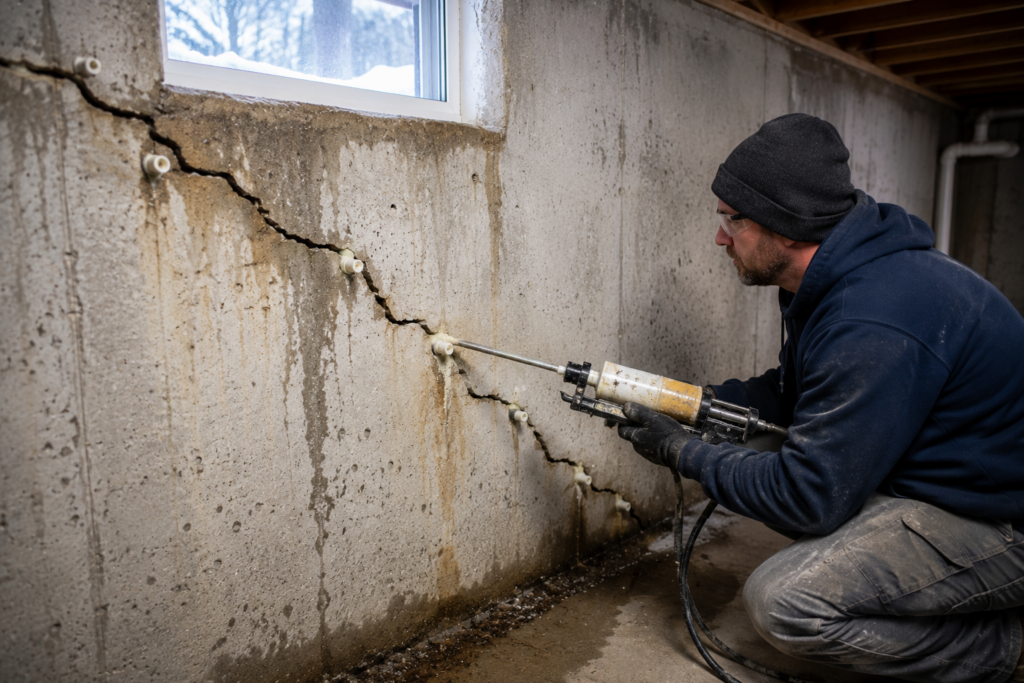
For dry structural cracks that require restoration of the wall’s original strength, contractors commonly use low-viscosity structural epoxy injection. The epoxy penetrates deep into the fracture before curing into a rigid, high-strength bond that reconnects separated sections of concrete and restores much of the wall’s original tensile capacity.
When cracks are actively leaking groundwater, polyurethane foam injection is generally the preferred solution. Unlike rigid epoxy, polyurethane expands after injection, filling tiny voids and creating a flexible waterproof seal that continues accommodating small seasonal movements without allowing water to re-enter the basement.
Each repair method serves a different purpose:
Structural Epoxy Injection
- Restores structural integrity.
- Bonds separated concrete together.
- Ideal for dry structural cracks.
- High tensile strength after curing.
Polyurethane Foam Injection
- Stops active groundwater leaks.
- Expands into fine cracks and voids.
- Remains flexible during seasonal movement.
- Creates a long-lasting waterproof seal.
Selecting the correct repair method depends on whether the crack is primarily a structural concern, a water intrusion problem, or both. In many situations, a comprehensive inspection is needed to determine the underlying cause before repairs begin.
Scheduling a professional inspection ensures you receive targeted professional foundation crack repair in Cambridge before the next hard frost worsens the structural gap.
Winter Moisture Management and Foundation Insulation
Preventive Steps for Cambridge Homeowners
While freeze-thaw damage cannot be completely eliminated in New England, homeowners can significantly reduce the risk of foundation movement by managing moisture before freezing temperatures arrive. The less water surrounding your foundation during winter, the less opportunity there is for frost heave, concrete spalling, and structural cracking to develop.
One of the most effective preventive measures is controlling groundwater around the home’s perimeter. Rainwater and melting snow should always drain away from the foundation rather than collecting beside basement walls. Proper grading allows water to flow away naturally, reducing soil saturation before freezing weather begins.
For homes with crawl spaces, installing rigid foam insulation along exposed foundation walls helps reduce temperature fluctuations and limits the amount of freezing that occurs immediately adjacent to the structure. Proper insulation also improves energy efficiency while helping protect pipes and structural components from extreme winter temperatures.
Routine gutter maintenance is equally important. Ice dams, clogged gutters, and blocked downspouts often allow melting snow to overflow directly beside the home’s foundation. This concentrated moisture quickly saturates surrounding soils, creating ideal conditions for frost expansion during the next overnight freeze.
Homeowners should also inspect downspout extensions to ensure runoff is discharged several feet away from the building. Even a properly functioning gutter system provides limited protection if water is released immediately beside the foundation footing.
Additional preventive measures include:
- Keeping gutters and downspouts free of leaves and ice buildup.
- Extending downspouts well away from the home’s foundation.
- Maintaining positive soil grading around the perimeter.
- Repairing foundation cracks before winter moisture enters them.
- Sealing deteriorated concrete surfaces vulnerable to water absorption.
- Monitoring basement humidity and moisture throughout the winter months.
- Removing snow piles that remain stacked directly against foundation walls for extended periods.
- Scheduling annual foundation inspections before or immediately after winter.
Preventive maintenance is often considerably less expensive than repairing structural damage after several years of repeated freeze-thaw cycles. Small improvements to drainage, insulation, and moisture control can greatly reduce the stresses placed on your foundation each winter.
Frequently Asked Question
Can foundation cracks close during the summer?
Yes—some foundation cracks caused by frost heave may partially close during warmer months as frozen soils thaw and the ground settles. However, this seasonal movement should not be mistaken for permanent healing.
The crack itself remains a point of structural weakness. During the next winter, groundwater can once again enter the damaged area, freeze, expand, and reopen the crack even wider than before. Each freeze-thaw cycle places additional stress on the surrounding concrete, gradually increasing the size of the fracture and allowing more moisture to penetrate the foundation.
If you notice cracks that widen during the winter, shrink during the summer, or repeatedly leak during spring thaw, it’s a strong indication that seasonal movement is actively affecting your foundation. Having these conditions professionally evaluated before another winter arrives can often prevent more extensive structural repairs later.
Schedule a Pre-Winter or Post-Thaw Structural Inspection
Winter weather places unique demands on foundations throughout Cambridge. Every freeze-thaw cycle, heavy snowfall, and spring thaw subjects basement walls, footings, and crawl spaces to repeated expansion, contraction, and moisture intrusion. While these forces often begin by creating small cracks or minor surface deterioration, they rarely stop on their own.
Waiting until spring flooding, widening cracks, or significant wall movement becomes obvious often results in more extensive—and more expensive—repairs. Early inspections allow developing problems to be identified while repair options remain less invasive and more cost-effective.
At Boston Foundation Repair, our structural evaluations go beyond simply measuring visible cracks. We assess how freeze-thaw cycles, frost heave, groundwater, drainage conditions, footing depth, and concrete deterioration are affecting your home’s foundation as a complete system. By identifying the root cause of winter damage, we can recommend repair strategies that address both the structural issue and the environmental conditions contributing to it.
Whether your home requires structural epoxy injection, polyurethane crack sealing, spalled concrete restoration, foundation stabilization, or deeper footing support using engineered pier systems, every repair plan is tailored to the specific conditions affecting your property.
If you’ve noticed widening basement cracks, concrete flaking, sticking doors, uneven floors, recurring moisture, or signs of frost-related movement, don’t wait until another New England winter makes the damage worse.
Schedule a pre-winter or post-thaw structural inspection to determine whether your foundation has been affected by frost heave, freeze-thaw deterioration, or seasonal structural movement. Early diagnosis is one of the most effective ways to protect your home, preserve its structural integrity, and avoid costly repairs in the future.